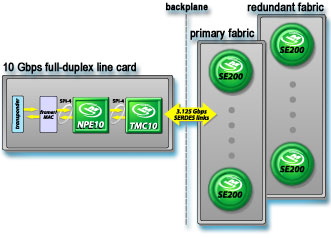
 The SE200 is the highest capacity, single-chip switch
element available today. A single chip delivers
200 Gbps of switching capacity, and larger fabrics
using multiple SE200 devices in parallel are able
to deliver terabit speeds. Sixty-four embedded serializer-deserializer
(SERDES) transceivers optimize performance and integration
efficiency in backplane and shelf-to-shelf interconnection
schemes.
The SE200 is the highest capacity, single-chip switch
element available today. A single chip delivers
200 Gbps of switching capacity, and larger fabrics
using multiple SE200 devices in parallel are able
to deliver terabit speeds. Sixty-four embedded serializer-deserializer
(SERDES) transceivers optimize performance and integration
efficiency in backplane and shelf-to-shelf interconnection
schemes.
The
SE200 is based on Internet Machines' patent-pending
Parallel Channel Architecture (PCA), which allows
system designers to develop high-performance multi-gigabit
switches that can scale in aggregate and per-port
bandwidth capacity, as well as overall system
port density, in flexible increments. The primary
function of the SE200 is to provide high-speed
switching between a source and destination port,
supporting multiple network interfaces or line
cards. Through its innovative virtual link aggregation
capability, the SE200 supports switching for multiple
concurrent protocols and services for any size
packet at any data rate from OC-48c to OC-768c.
For high-end switching applications, multiple
SE200's can be designed into a single stage topology
to scale fabric capacities to 1.2 Terabits per
second.
Highly
integrated. Single chip, 64 x 64 port, non-blocking,
self-routing, buffered crossbar switch element
delivers 200 Gbps switching capacity, and a fabric
using multiple SE200 devices can deliver terabit
speeds. Integrated full duplex SERDES transceivers,
with optional ECC for reducing link error rates,
optimizes performance and increases integration.
Concurrent protocol independent, multiservice
support. The SE200 allows concurrent switching
of multiprotocol and multiservice traffic.
Flexible.
Flexible architecture scales up to 1.2 Tbps of
non-blocking switching capacity with up to 64
line cards, each supporting traffic throughput
of up to 10 Gbps/OC-192c, using multiple switch
elements in parallel. Larger fabrics and port
densities can be supported in the future using
multi-stage topologies.
Features
and Benefits
|
 |
- Performs
both variable-length or fixed-length
PDU switching
- All
ports include on-chip embedded
full-duplex SERDES links,
with optional ECC for reducing
link error rates, for optimal
performance and integration
efficiency
- Provides
an on-chip SRAM buffer for
storing and scheduling packets
during temporal congestion
in the fabric, eliminating
the need for external components
in the fabric subsystem
- Connects
directly to Internet Machines'
TMC10 traffic manager, or
interworks with other traffic
management solutions
- No
synchronization required between
different links or different
switching elements, simplifying
design of backplanes and multi-shelf
systems
- Distributed
architecture allows for N+1,
N+2, and 1+1 redundancy options,
with zero packet loss fail-over
capability to maximize carrier-class
availability and reliability
- Programmable
association between logical
port numbers and physical
links and auto link diagnostics
allow simple rerouting of
traffic to bypass link failures
-
Supports separate CRC validations
to check header integrity
independently from payload
integrity
-
Supports spatial multicasting
-
Provides a dedicated high
priority in-band messaging
path, allowing for flexible
flow control schemes between
ingress and egress line cards
to manage traffic flow across
the fabric subsystem
-
Offers flexible fabric configuration
andmanagement capabilities
-
Memory BIST, JTAG (IEEE P1149.1
standard), and scan function
|
|
|
 |
|
|