|
The
rapid increase of multiprotocol networks carrying converged
voice, video, and data traffic is driving the need for
a new approach to the core components used to build
infrastructure products. Historically, companies have
developed application specific integrated components
(ASICs) specifically designed for a particular product
in the network.
An
emerging class of products called network processors
with sophisticated packet handling capabilities aim
to deliver highly-programmable, flexible, scalable core
technology that will give equipment vendors a distinct
time to market advantage over the traditional ASIC-based
approach.
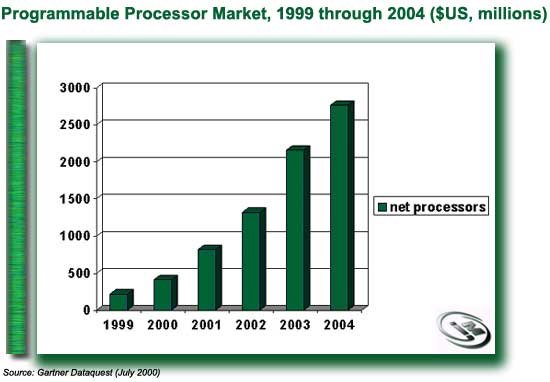
According
to Dataquest, the network processor market will reach
almost $2.8 billion in 2004, with a 66.5 percent compounded
annual growth rate from 1999 through 2004.
|
|
Dataquest
also observes that network processors, with their ability
to provide the sophisticated packet processing required
for forwarding, classification, provisioning, policy
enforcement and other features, are well-poised to support
the needs for quality of service (QoS), security, and
other services.
The
time to market argument is indeed compelling, as the
life cycles of network systems decrease and competition
increases. Because the use of network processors can
greatly reduce the time system vendors would need to
design an equivalent ASIC, a dramatic reduction in time
to market is achievable. In addition, field programmable
processors allows for upgrades to existing systems,
which is not possible in ASIC-based designs. The ability
to add features and functionality to systems that are
already in service results in faster delivery of increased
capabilities to the ultimate recipients of the network:
the end user.
|