|
|
 |
|

|
|
 Internet
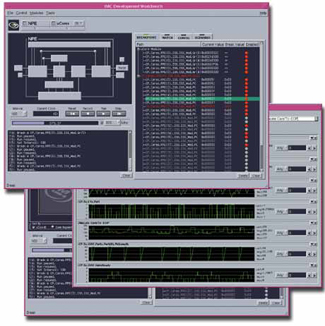
Machines' Development Workbench is
a full featured, graphical, and easy-to-use
software development kit that allows
rapid development of application-specific
fast path forwarding code for Internet
Machines' NPE10 network processor.
The kit provides a complete, clock
cycle-accurate software simulator
of the NPE10, along with tools for
designing, debugging, and optimizing
fast path code. The Development Workbench
enables development of forwarding
code early in the system development
cycle, greatly accelerating system
time to market. Internet
Machines' Development Workbench is
a full featured, graphical, and easy-to-use
software development kit that allows
rapid development of application-specific
fast path forwarding code for Internet
Machines' NPE10 network processor.
The kit provides a complete, clock
cycle-accurate software simulator
of the NPE10, along with tools for
designing, debugging, and optimizing
fast path code. The Development Workbench
enables development of forwarding
code early in the system development
cycle, greatly accelerating system
time to market.
Easy
to use. The Development Workbench
provides a single threaded, single-processor
programming model and interfaces to
a wide range of standard tools to
simplify code designs.
Full featured. The Workbench
includes traffic generation tools
for creating simulated real-world
traffic patterns, which allows designers
to evaluate how their forwarding code
performs under stress. Debugging tools
test and optimize the execution of
forwarding code, and performance analysis
tools monitor system behavior and
isolate system bottlenecks. An application
library includes pre-coded modules
for critical functions common in network
switching equipment and sample reference
code for data path applications. A
Tcl command line interface (CLI) is
also available for more advanced programming.
Since
the NPE10 is fully software programmable,
the Workbench facilitates quick response
to specific customer needs, increasing
customer satisfaction. It also speeds
the development of
features required to secure a competitive
edge in the growing high-speed networking
market.
|
Development
Workbench Features
|
 |
|
Simulator
|
-
Clock
cycle-accurate
NPE10 simulator
with concurrent
execution
of all processor
cores running
multiple
fast path
code streams
on different
processors
- Dynamic
display
of currently
executing
and available
processor
cores as
they are
allocated
and de-allocated
for packet
processing
- Emulation
and diagnostics
of all hardware
assist functions
for visibility
into all
aspects
of fast
path forwarding
- Optional
Tcl command
line interface
available
for advanced
programming
|
|
Debugger
|
- View
assembly
level forwarding
code instructions,
along with
register
contents
and status
flags associated
with any
processor
core
- Set
breakpoints
and watchpoints
by code
instruction
location
or by register
value to
trigger
processor
halt for
system snapshot
and monitor
variables
of interest
- Control
execution
of forwarding
code by
using Run,
Pause and
Step clock
commands.
Record a
run to a
file for
restart
later
|
|
Performance
Analyzer
|
- Dynamically
view overall
system performance
while simulation
is in progress
- Track
packets
through
different
events as
they are
allocated
and de-allocated
for fast
path processing
- View
a variety
of performance
charts,
including
statistical
analysis,
traces on
packets/flows/ports,
clock cycle
counts and
memory touches
history,
processor
efficiency
statistics
and resource
utilization
histograms
|
|
Traffic
Generator
|
-
Watch
SPI-4 traffic
showing
header and
payload
data as
each packet
enters and
exits the
NPE10 simulator
- View
traffic
statistics
such as
packet length,
sequence
number,
start of
packet (SOP),
and end
of packet
(EOP) for
each SPI-4
channel
|
|
Other
Features
|
-
Pre-coded
application
code samples,
including
IPv4, MPLS,
DiffSrv,
and more
-
Full set
of portable
device APIs
providing
diagnostics,
initialization,
and other
common functions,
along with
a convenient
software
interface
to higher
level control
plane for
accessing
and controlling
all device
resources
- Works
with GNU
assembler
and compiler
for fast
path code
development
- NPE10-based
hardware
evaluation
board is
accessible
through
the Workbench
GUI, enabling
rapid development
of application
code
|
|
|
|
 |
|
|
|
©
2001 Internet
Machines Corporation. All rights
reserved. Internet Machines, its associated
logo mark and IMpower are trademarks
and service marks of Internet Machines
Corporation.
Specifications are subject to change
without notice. Contact your nearest
Internet Machinesrepresentative for
additional information.
|
|
|
| |
|
| |
|
|
|