|
MEDIA
& TECHNOLOGY
Investors
Keen on High-Flying Chip Firm
BY
JOHN BRINSLEY Staff Reporter
 Even
as Internet content companies drop like flies,
the race to deliver data, voice and video traffic
ever faster is spurring investments in new firms
convinced they can do just that. Even
as Internet content companies drop like flies,
the race to deliver data, voice and video traffic
ever faster is spurring investments in new firms
convinced they can do just that.
One
such company is Agoura Hills-based Internet
Machines Inc., which despite being
less than a year old has garnered over $40 million
in venture capital and has grown to more than
100 employees.
Internet
Machines
is one of several companies working to build ever-faster
network processors – the semiconductor chips
embedded in large Internet infrastructure equipment
such as
routers and switchers that send massive amounts
of digital data through cyberspace. The next-generation
“wafers” are distinguished from previous
generations by two very important features: adaptability
and speed. Until now, companies have developed
application-specific integrated components, or
ASICs, that work on one particular product within
the network. Now, a few startups are developing
chips that are programmable and can be upgraded
as the network infrastructure adapts. In addition,
these silicon chips are up to four times faster
than the current generation, moving 10 gigabytes
of data per second as opposed to the current top
speed of around 2.5 gigabytes. As a result, the
company that delivers these flexible, high-speed
silicon chips first is likely to make a lot of
money.
“The
Internet is predicated on information moving through
it at very high speeds,” said Internet Machines
President Chris Hoogenboom. “The Internet
is evolving very quickly with many different protocols
used. Right now, a chip for an Internet router
is different from a chip for a modem. Because
there are so many protocols, it’s useful
to have a programmable chip to read all of them.
It allows products to evolve as Internet protocols
evolve.” With the Internet flowing through
modems, cable, DSL and cell phones, the programmable
network market is poised to explode, Hoogenboom
says.
Telecommunications
companies of all kinds will need these chips to
survive, and research firm Dataquest predicts
sales will jump from $816 million next year to
$2.8 billion in 2004.
“Network
processors have already and will continue to change
the way the industry does business,” said
John Metz, vice-president at Sterling Research,
a Massachusetts-based technology research firm.
“Until now, there’s always been a compromise
between how much you do in hardware and how much
you do in software in building these networks.
With software, you can go in and program (systems),
change things. It gives you flexibility. With
hardware, you get extremely high speeds. Network
processors are fully programmable. There’s
no forklift upgrade necessary.”
That’s
going to be of paramount importance to companies
that design the infrastructure systems behind
the Internet such as Lucent Technologies Inc.
and Nortel Networks Corp.. Network processors
will make the job of such companies easier by
saving time and money replacing ASICs as the system
evolves. Hoogenboom says the company has several
potential customers and partners but declined
to give details.
“There
are so many new systems, so many of these large
(network) boxes that aren’t out for more
than a year or two,” Metz said. “If
you have network processors, if something changes,
you can program it and keep the system in place
for up to five years. From the guys who make the
chips to the Ciscos and Nortels, to the start-ups,
everybody wins along the value chain.” Internet
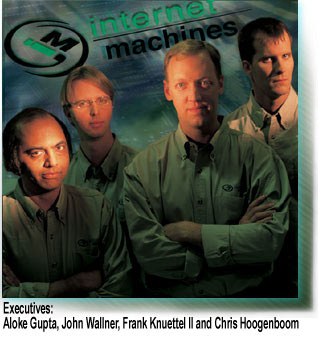
Machines was started by four partners. Three are
engineers who came out of network design company
Xylan Corp.
Internet
Machines’ next challenge is getting out a
product. The chips take months to design and manufacture,
and Hoogenboom predicts production will start
before the end of 2001. As Metz points out, venture
capitalists are standing in line to give network
processing companies money, and Internet Machines
has a few competitors, one an Israeli company
and another in Silicon Valley. But Hoogenboom’s
outfit just raised more than $31 million in its
second round of financing from investors, including
Morgan Stanley Dean Witter, Redpoint Ventures
and Meritech Capital Partners. That money should
be more than enough to get the company through
next year and deliver its product to market.
“These
guys were a very successful team at Xylan, and
they’re targeting what we think will be a
very high-growth period in technology,” said
Meritech Capital Managing Partner Mike Gordon.
“Starting (to get product out) by late 2001
we think is fast enough, given the power and performance
of Internet Machines’ processors. There’s
nothing out there that can compare with what these
guys can deliver.”
|